Before It Had a Name
Before It Had a Name

There's a kind of guy who figures he could live just about anywhere. No real roots, no soil under the fingernails, no town that would notice if he left. I'm that guy. Or I was pretty sure I was, right up until a database told me otherwise.

I came up a city kid. I move through the modern world the way most of us do now — half of me lives on a screen. I've got a homelab humming in the next room, a rack of servers with names I gave them like they were pets, an Obsidian vault that holds more of my memory than my actual head does. I ride a Harley. I play guitar at a volume my girlfriend has opinions about. On paper I'm about as rootless as a person gets. The kind of guy who belongs to the internet more than to any particular patch of ground.

So when I landed in Sandy Hook — Goochland County, Virginia, a place most people couldn't find on a map and wouldn't look for — it felt like what it was. A dart thrown at a map. I wanted land, quiet, room for the dogs to be idiots. I did not move here because of some half-remembered family story or a pull in the chest. There was no pull. There was a good price and a lot of trees, and to a lesser degree, I thought the name was funny. What the Hell is a gooch anyway.

And I'll be honest about the part that's a little uncomfortable. Out here, I'm outnumbered. I'm a liberal in a stretch of Virginia where that's not the popular team, and I've made my peace with it mostly by making jokes about it. The lone blue dot at the county store. You learn to keep some opinions in your pocket. You wave at neighbors you disagree with about nearly everything, and you mean the wave, and that's just rural life. I figured I was the newcomer here. The transplant. The guy who showed up.

Then I got into genealogy. It makes sense if you know me. I'm a tech guy by trade — my whole job is staring at oceans of data until a pattern surfaces, correlating one stray signal against another until a story falls out of the noise. But I'm a history major underneath all that, and the two halves have never really been separate for me. History is just the original big dataset — names and dates and movements, waiting for somebody to find the thread that connects them. A family tree is both at once. The pattern-hunt and the history, pointed straight at my own blood.

It started innocent, the way these things do. A GEDCOM file from ancestry.com, a rainy weekend, the engineer's itch to follow a thread and see where it goes. And it went. It went to four thousand four hundred people before I came up for air. There's a witch back there I share with Margaret Atwood. There's an Irish pirate queen. There's a Scottish Highland Jacobite line, a Bohemian peasant who got on a boat in Hamburg in 1867 — the actual reason I exist, that one, though I'll get to him another day. It's a circus back there. Everybody's tree is, if you climb high enough. That's not the part that got me.

The part that got me was a woman named Anne Cosby.

Anne was born in 1715. She lived her whole life and died in 1786, and she did all of it right here. Goochland County. A few miles from where I'm sitting typing this, where the dogs are asleep, where I throw a leg over the Harley on Sunday mornings. Not the same state. Not the same region. The same dirt. My family's first stand in this country was made on the ground I accidentally moved back to, two hundred and fifty years after she was cold in it, and I didn't know she had ever drawn a breath.

Let that sit the way it sat with me. I didn't come home. I got brought home, by nothing I could name, and only found out the word applied after I'd already built a life on top of it.

Now here's where it gets strange, and where the whole thing I thought I knew about myself started to tilt.

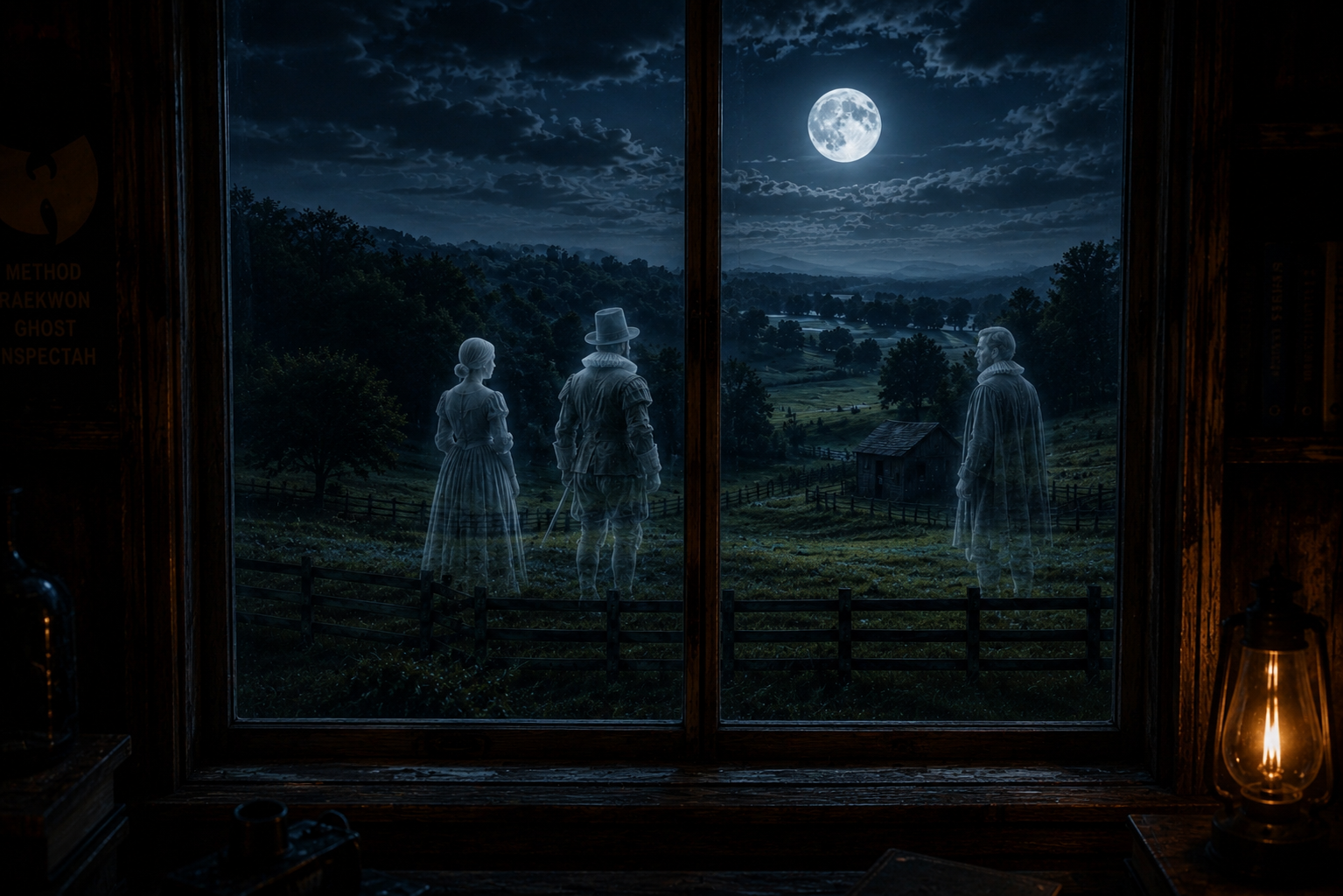
Anne was born in 1715 — but Goochland didn't exist yet. The county got carved out of Henrico in 1728, when she was about thirteen years old. So when she came into the world on that ground, the ground had a different name. The map hadn't caught up to her yet. She was there first, and the lines got drawn around her later. And it doesn't stop there, because she was born sixty-one years before there was a country called America to be born in. She lived her whole childhood, her whole marriage, raised every one of her kids as a British colonial subject on that dirt — and then got ten more years on the far side of the line, an old woman watching a brand-new nation get its name pinned on around the only home she'd ever had. Born under a king. Died under a republic. Never went anywhere.

The names came to her. The county's name. The country's name. She didn't chase a single one of them. They arrived, one after another, and found her already standing there.

And me — the rootless guy, the transplant, the lone blue dot who figured he was the johnny-come-lately in this whole equation — it turns out my claim to this soil is older than damn near everyone's I wave at. I spent years feeling like I didn't belong here. Anne had been belonging here since before the word "here" had been invented.

That should've been a warm story. A nice one. Guy finds out he's secretly local, roll credits.

It didn't stay nice. Because once you start pulling a thread like Anne, the thread keeps coming, and it runs back across an ocean, and it gets dark fast.

The name is Cosby. That's the thread. And it runs back out of Goochland, back across the Atlantic, back through the colonies into England, and then it lands in Ireland in the 1500s, and that's where I had to stop and read the same paragraph about four times to make sure I had it right.

There was a man named Francis Cosby. Born around 1510, an English soldier, and he went to Ireland to do what Englishmen of a certain stripe went to Ireland to do in those years — take it. This was the Tudor conquest, the long ugly business of England deciding the Irish were in the way of their own country. Francis got himself granted a dissolved abbey at Stradbally, in what they renamed Queen's County, after the Catholic monks were cleared out of it. Confiscated ground. Somebody else's land, handed to a settler with a sword and a writ. I want to be clear about what "settler" means here, because the word's gone soft on us — it means a man who arrives on land that is already full of people and sets about emptying it.

And then there's the thing he's actually remembered for. The thing with his name welded to it for four hundred years.

In 1578, in a place called Mullaghmast in County Kildare, Francis Cosby invited a band of the local Irish — the O'Mores, the family that had held that country for longer than England had been a notion — to come and talk. A parley. Safe conduct. Some accounts say a feast. Peaceful business, guaranteed. About seventy of them came, and they came unarmed, because that was the whole point of a parley, and they rode into the fort, and Cosby's men closed the gates and surrounded them and cut them down to the last man. The old Irish annals didn't reach for careful language. They called it treachery, abominable, a slaughter where not one soul got out alive. Guests. He killed his guests. He used their trust as the weapon — invited them in with trust precisely so he could spring it shut.

That's my name. That's the name.

I need you to feel the full weight of what that does to the rest of this, so stay with me. Remember Anne — born 1715, here before the county had a name, the woman whose discovery made me feel like I'd been carried home by some force I couldn't see. Anne married a Dickerson. Had thirteen children. And when the dust settled — widowed, the Dickerson men in the ground — every last one of those thirteen kids carried the name Cosby. Not their father's name. Hers. She reached back past her own marriage, past the man she'd buried, and picked up the name she was born with, and laid it over all thirteen of them like a brand on cattle. In a place and a century where a wife's name was supposed to dissolve into her husband's the instant the vows were done, that is not a small thing. That's a woman refusing to disappear. She didn't just keep the Cosby name. She overwrote a whole generation with it and sent them marching forward into a country that didn't exist yet.

And it kept marching. Two hundred and fifty years it marched, down through people I'll never know the faces of, until it came to rest on a guy on a Harley in Goochland who felt the name like a homecoming.

One of those thirteen was a boy named Hickerson Cosby. Hold onto him. He comes back.

The name that felt like home is the name of a man who made a home for himself by murdering the people who were already home.

I sat with that for a long time. I'm still sitting with it.

And it didn't even stop there, because the Cosbys weren't lone wolves — they were connected, and the way they were connected makes the whole thing colder. Francis's son Alexander — who, in one of those details that's almost too neat, had himself been grabbed by the O'Mores at a parley a year before his father turned the same trick around on them — Alexander married a woman named Dorcas Sydney. And Sydney is not a random name to find here. Dorcas was kin to Sir Henry Sidney, and Sir Henry Sidney was the Lord Deputy of Ireland. He was the Crown's top man in the country. He was the administrator the records name as having blessed the Mullaghmast killing from his end of things. So follow the wiring: the man who did the massacre, and the official who sanctioned it, became in-laws. The atrocity wasn't some rogue act by a violent crank on the frontier. It was a family business, and the families married each other to keep it in the family. You could draw it as an org chart. It would have a marriage certificate stapled to it.

Here's the part that reached into my chest and grabbed something personal, though. That same Sidney family — Sir Henry — was the father of Sir Philip Sidney. If that name doesn't ring a bell, it's okay, but Philip Sidney is one of the great poets of the English language, an Elizabethan giant, the kind of name that gets carved over library doors. So braided into this exact knot of blood, the knot that holds Mullaghmast, is one of the founding voices of the literature I've spent my whole life loving. I'm over here trying to write a sci-fi novel. I play music because I don't know how to not. And I share a branch with the poet — and with the butcher — and they're the same branch. I can't pull the poet out without the murderer coming up attached to him by the root.

And then. And then. Because the universe apparently wanted to make sure I never sleep easy about any of this again — somewhere else in that same tree of mine is Grace O'Malley. The Irish pirate queen. Gaelic nobility. Which is to say: the exact kind of Irish that the exact kind of Englishman like Francis Cosby spent his life grinding into the dirt. I almost certainly carry both of them. The conqueror and the conquered. The hand on the sword and the throat under it. Same body. Mine. I am, in the most literal blood-and-bone sense, the descendant of people who did this and the people they did it to, and the only reason I'm here to type that sentence is that the whole catastrophe happened and somehow both sides of it survived long enough to eventually, improbably, meet in me.

There's a piece of Irish folklore I found that I can't stop thinking about. The hatred for the Cosbys ran so deep, for so long, that the stories started claiming an avenging O'More had wiped the whole line out — son and grandson dead in a single day — until people wondered aloud whether anyone with a drop of Cosby blood was left walking the earth at all. A curse, basically. A wish dressed up as history: let there be none of them left. The wronged trying to will the bloodline out of existence.

It didn't take. Obviously. The line lived. It crossed the ocean. It became a woman named Anne, standing on Virginia ground before that ground had a name, reaching back to pick the name up again and press it onto her son. And it kept going, and it became me.

So here's where I've landed, and I'll warn you it's not a tidy place.

I came out here feeling like the outsider. The transplant, the city kid, the lone liberal keeping half his opinions in his pocket at the county store, sure that everyone around him had more claim to this place than he did. And the dirt's answer to that, when I finally listened, was that my people were standing on it before the county, before the country, before the names. I belong here in a way that has nothing to do with whether anyone agrees with me. That was supposed to be the comfort.

But belonging, it turns out, is not the same animal as innocence. The same soil that holds Anne, that holds my claim to this quiet patch of Goochland — that claim runs straight back through a man who took his patch of ground the way ground has always been taken. By deciding the people already there didn't count. By deciding who belonged and who could be cleared away. Mullaghmast wasn't a war. It was a sorting. It was a man with power looking at a room full of human beings and deciding they were the wrong kind, and acting on it, and calling the leftover land his home.

And that's the thing I can't put down, the thing that turns this from a fun ancestry story into something that keeps me up. Because I look at my own country right now — at the men deciding who belongs and who gets cleared away, who's the right kind and who's vermin to be removed, who gets to call this ground home and who gets dragged off it — and I don't have to imagine where that impulse leads. I've got the receipts. It's in my own name. Four hundred years back, my own blood ran the experiment, and I know exactly what it costs, because the people it cost are also in my blood, screaming up through the same family tree.

Now here's where Hickerson comes back, the boy I told you to hold onto. Anne's son. One of the thirteen she branded with her name. He grew up and he went to war — the Revolution, the American side, a sergeant. A Cosby pointed a musket at a king's army and fought to tear an empire off this continent. And I need you to feel the symmetry, because it's almost too much to hold: the name was forged serving a crown. Francis built it doing a king's conquering for him, gates closed on unarmed men. And two centuries later the same name — my name — is carried by a man trying to rip a crown's grip loose from a country. The name that did the conquering also did the rebelling. The same blood, pointed at empire from both ends, two hundred years apart.

I want that to be the redemption part so bad. I want it to be where the family finally squares the ledger and I get to exhale. But it isn't, and I'd be lying to you and to myself if I sold it that way. It's not an arc. It's just the same truth getting louder — the name was never one thing. It conquered and it rebelled and it murdered its guests and it raised thirteen kids and it crossed an ocean and it ended up asleep next to four dogs in Goochland. You don't inherit a verdict. You inherit a contradiction, and you carry it in your chest your whole life whether or not you ever go looking for its name.

I don't get to feel clean about this. That's the honest end of it. I can't conscript Anne onto my side, and I can't disown Francis off it, and I can't pretend the poet's gift came to me down some separate, nicer pipe than the killer's appetite did. They came together. They always come together. A human being is the whole catastrophe and the whole grace of the species carried in one nervous body, and most of us just never look back far enough to see the bill.

I looked. I moved to nowhere, Virginia, by accident, and the ground I landed on turned out to be the ground my family first took and first held and first called home — and "home," it keeps reminding me, has always been a word with blood under it. Anne knew that. She lived through the actual founding of the actual country, the real one, not the cartoon. She'd have understood the part I'm only now catching up to: that the ground doesn't care who deserves it. It just keeps whoever's standing on it, and waits, and lets the names arrive.

I'm one of the names that arrived. I know what the name carries now. The least I can do is not pretend I don't.