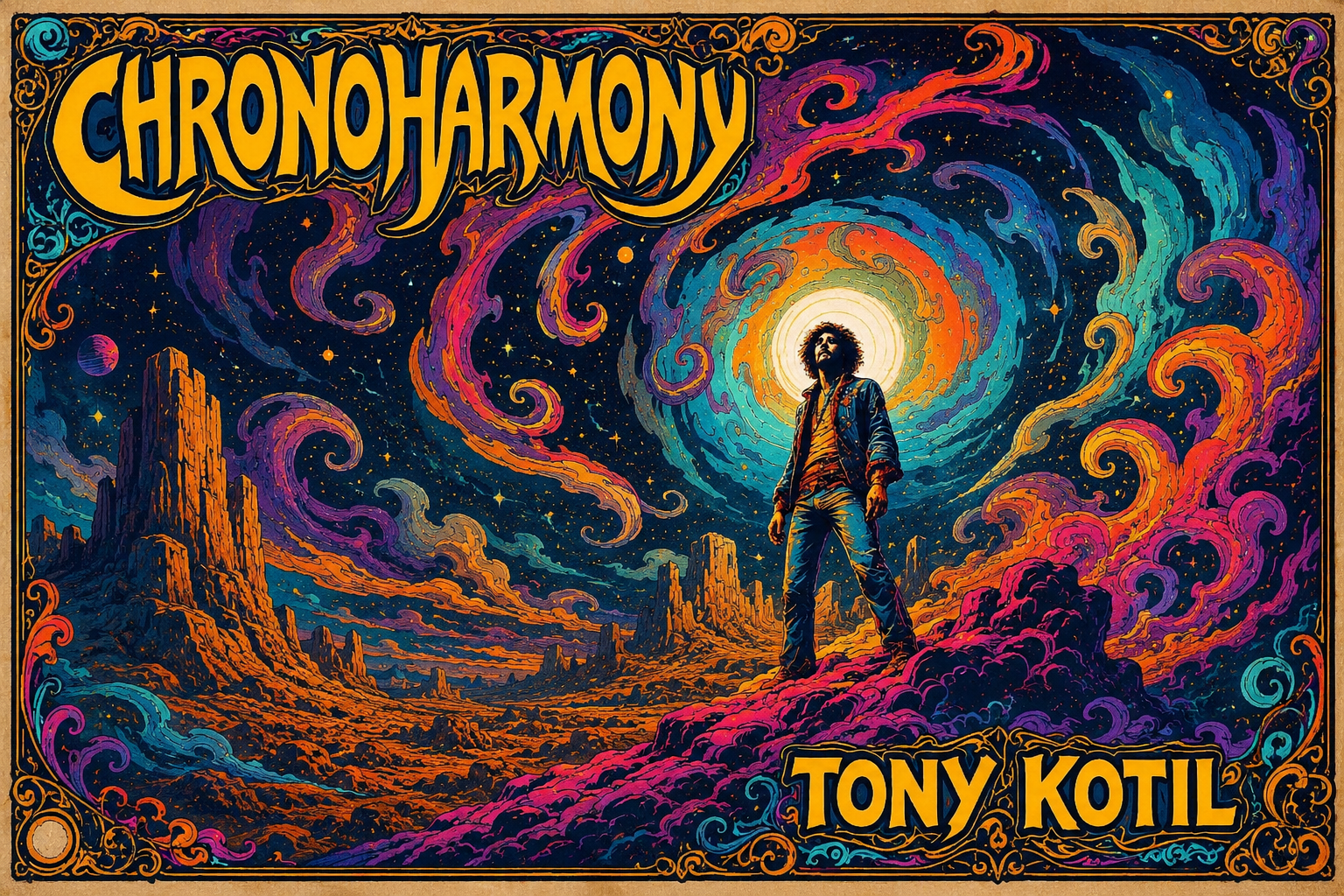
Chronoharmony
I'm not a novelist. Let me get that out of the way up front.
By day I'm a cybersecurity engineer. The kind of person who reads technical manuals for fun and gets weirdly excited about compliance frameworks. So when I tell you I've been spending my evenings and weekends writing a science fiction novel about a session guitarist who steals a time machine to fix the music industry... yeah. I hear it. I hear exactly how that sounds.
But here we are.
The book is called Chronoharmony. And before I get into what it's about, I need to talk about why it exists. Because the reason matters more than the plot, and honestly, the reason is the only thing keeping me at the keyboard at midnight when my dogs are giving me looks like "are you really doing this right now."
The Real Problem
I was raised in music. Not introduced to it. Not exposed to it. Raised in it.
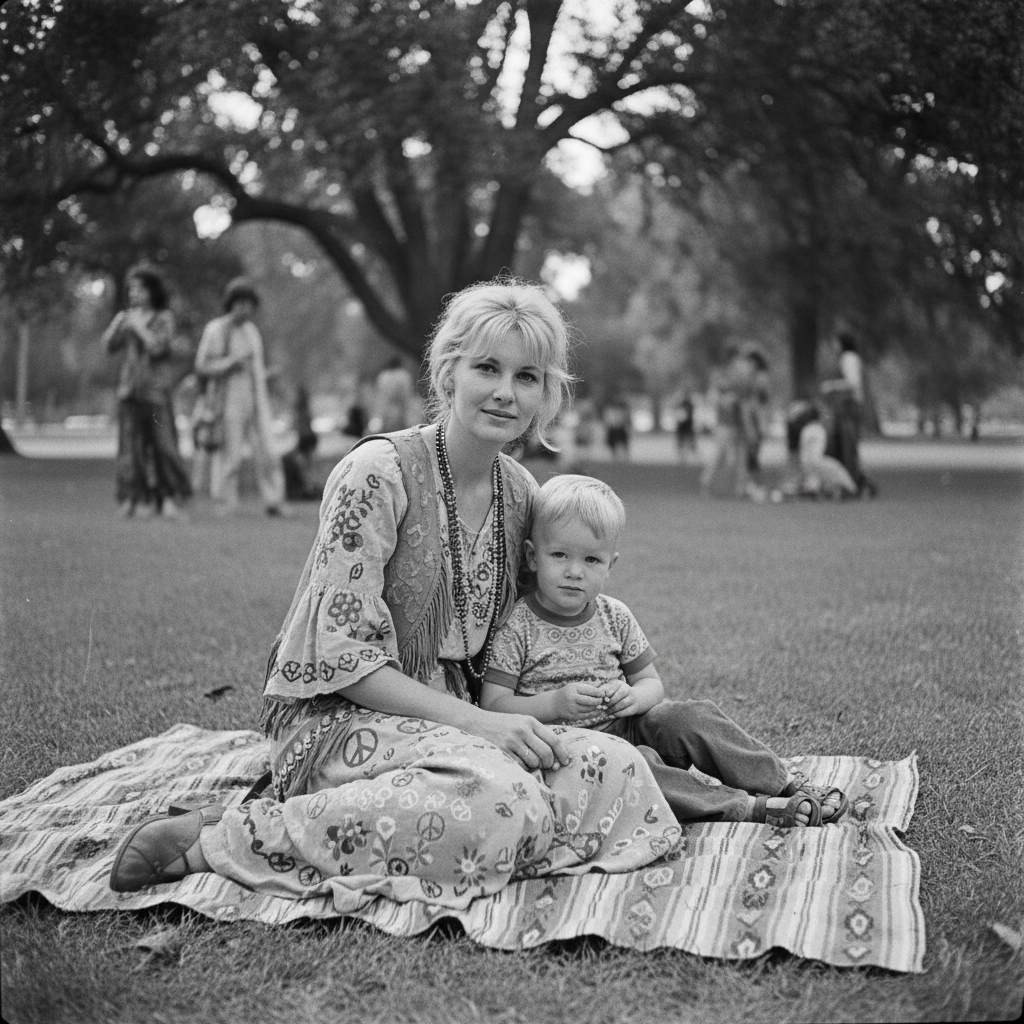
My mother was a flower child of the 60s, and I'm fairly certain I was conceived in a VW van at a Grateful Dead show. Some things you just accept. Some of my earliest memories are of being held in her arms while the Dead played from wherever the record player happened to live that week. Before I could form a sentence, I knew what music felt like filling up a room.
One of the first photos of myself I can actually remember — like, remember the moment, not just the picture — is me at maybe 2 years old, sitting on a bed, holding Cream's Disraeli Gears. Holding it might be generous. I was chewing on it. Gnawing on the corner of the sleeve like a puppy with a tennis ball.
That photo's long gone now. Lost to time, lost to a few too many moves, the way the ones you'd actually want to keep always seem to be. The picture above isn't that one — it's just my mom and me, one of my favorites of the two of us. But you get the idea.
I had taste before I had teeth.
From there it was a slow, loud march. Psychedelic rock first — Hendrix, Floyd, the Doors, the stuff I absorbed by osmosis whether I wanted to or not. Then what you'd now call classic rock but at the time was just "the radio." Zeppelin. Stones. The big loud middle of the dial.
Then I got political. Or angry. At that age, they're kind of the same thing.
Punk rock found me right when I needed it most. Black Flag, Dead Kennedys, Bad Brains, the Clash. Then heavy metal, because the volume kept climbing. Then old school rap hit me like a brick — Public Enemy, Wu-Tang, KRS-One, the kind of music that didn't ask permission and didn't apologize for existing. Parts of that phase still haven't ended. I'm 60 and there's a Wu-Tang shirt in my drawer right now.
Then somewhere in my 40s I mellowed. Or convinced myself I had. Jazz crept in — the Latin stuff especially, where the horns and the percussion are basically arguing and somehow both winning. Son cubano, Afro-Cuban, Colombian cumbia with its rolling accordion and a clave that won't quite sit still. Mambo. Salsa with the bottom turned all the way up. Turns out "mellowing" for me just meant trading one kind of loud for another. It's music you listen to with your hips as much as your ears.
So when I tell you music isn't a hobby for me, I mean it literally. It's been the through-line. Six decades, a couple of garages full of records, and a hearing range that's slightly worse for the wear.
And somewhere along the way, while I wasn't paying attention, the whole thing got... cooked.
Not killed. Music isn't dead. Don't let any 50-something with a "they don't make 'em like they used to" t-shirt tell you otherwise. But cooked, sure. Optimized. Tested. A/B'd to death. The chaos that made music feel dangerous and alive — the chaos that produced the Beatles and the Clash and Public Enemy and Nirvana and basically every band you've ever genuinely loved — that chaos has been ground down into something measurable.
Streaming platforms pay artists fractions of pennies per play. Algorithms decide what gets surfaced and what gets buried. Songs are written backward from the data now. Hook in the first eight seconds. Three-and-a-half minute runtime. Lyrical patterns that test well. Melodic structures the model says will pop on TikTok. We've taken the most human art form ever invented and turned it into a spreadsheet.
The kid who chewed on Disraeli Gears did not sign up for this.
That's the part that pisses me off. And that's where the book came from.
So I Wrote a Time Travel Novel About It
The real origin story goes back further than I usually admit.
Teenage me, Miami, Florida in the mid-80s. My best friend James and I are sitting in his 1967 GTO with the windows down and the stereo cranked past where it had any business being. Doing what teenage boys in muscle cars have done since muscle cars were invented — telling lies about girls, arguing about football, debating which summer concert mattered most. The usual.
Somehow the conversation drifted into time travel. I have no memory of how. Doesn't matter. The question came up, the way it always does:
"If you could go back anywhere, when and where would you go?"
Most people answer that one predictably. I'd go back and kill Hitler. I'd go back and save JFK. I'd go back and warn somebody about something. The big-swing answers. The ones designed to make you sound like you'd be a force for good if the universe ever handed you the keys.
Not us. We didn't go anywhere near history class. We went straight to the shows.
The Beatles at the Cavern Club, when nobody outside Liverpool had any idea who they were yet. The Stones at Altamont, knowing exactly what was about to go wrong and going anyway. Dylan at Newport in '65, the night he plugged in and the folk crowd lost its collective mind. Hendrix anywhere. Pick a year. Pick a venue. Just put me in the front row.
We must've sat in that GTO for two hours listing shows. We weren't trying to fix anything. We weren't trying to be heroes. We just wanted to be there. In the room. While it was happening. While it was still real and dangerous and unrepeatable.
That night planted something. I didn't know it at the time — I was a teenager and mostly focused on not failing geometry, or whether Betty was going to let me get to third base on Friday — but the seed went into the ground and just... waited. For decades. Like one of those tree seeds that needs a forest fire to actually crack open.
Forty-something years later, here we are.
When I finally started writing, the seed had grown into something more complicated than a list of dream concerts. The wide-eyed "I just want to see the shows" energy is still in there — the opening chapter drops a character at the Cavern Club, and he reacts exactly the way I would. That scene is basically teenage me in the front seat of a GTO, transposed onto a grown adult. But the rest of the story needed weight. It needed a reason for the time machine to exist beyond pure fanservice.
So I added a grudge. A real one — the kind you'd carry after thirty years of watching an industry chew up the people you came up with and spit out their royalty checks. I added stakes that compound. And I added people with good intentions and bad judgment, because that's the only kind worth writing about.
Then I built five acts around the question: what if those teenage daydreams about going to see the great shows turned into something darker?
No spoilers. Just enough to make you mad I'm not done yet.
Here's as much as I'll give you.
There's a physicist — Rich Alden. Builds prototype hardware to loud punk records at three in the morning, funded by a pile of Bitcoin he mined back when you could do it on a desktop and then mostly forgot he owned. The kind of guy you'd want as a friend right up until he accidentally tears a hole in the space-time continuum. He's built a wearable time machine. The wrist unit keeps you alive; a room full of supercooled computers back at the lab does the actual math. Cut the link and you don't come home. It has never been tested on a human — a problem Rich solves the way he solves most problems. Late at night. Alone. After a joint.
The first jump lands him in a Liverpool basement in 1962. You can guess who's playing.
Then he makes the mistake of telling his best friend.
Marc Cole is a session guitarist. Played on more hits than you've had hot dinners, never famous, never credited, quietly furious about thirty years of an industry getting rich off his hands. When the music guy realizes what the physics guy just handed him, he does the thing you're already dreading — he takes the machine and goes back to fix it. MTV. Napster. The streaming era. Three swings at the moment he's sure it all went wrong, each one Marc alone in some borrowed apartment, absolutely convinced this is the one.
You can probably guess how that goes.
Back in the present, Rich and his research assistant Maya are the only two people alive who can feel the world changing underneath them — bands that used to exist and now don't, a fight nobody else can even perceive. And a journalist named Nina is chasing it from the outside, following the seams Marc keeps leaving behind. By the time they understand what he's doing, decades have passed on his end. He's older. Exhausted. Nowhere near done.
How it ends is for the book. But I'll tell you this — the conversation Rich and Marc finally have, when they see each other again after all that time, is the conversation the entire story has been trying to have since the very first page.
Why This, Why Now
Look. I could've written a Medium post complaining about Spotify payouts. Plenty of people have. None of it changed anything — and here's the thing, I'm not trying to change anything either. I'm 60. I've watched this happen in real time, across my whole life. The royalty model is what it is. The algorithms won. The spreadsheet ate the art. That fight's over, and pretending a novel's going to claw any of it back would be a lie I'm too old to tell.
But losing a fight and forgetting it ever happened are two very different things.
Here's what actually keeps me up. There are grown adults walking around right now who've never held an album. Don't know what a B-side is. Never flipped a record over, never read the liner notes, never sat through track four just because that's where it lived and you didn't get to skip it. To them, music has always been a tap and a stream and a thing that lives in a glowing rectangle. That's not their fault. It's just the only water they've ever swum in.
And if nobody writes the rest down — what music used to be, and what got done to it in the name of greed and tech and "engagement" — then in fifty years it's not even a loss anyone can name. You can't miss what you were never told existed.
So that's the job I gave myself. Not fixing. Chronicling. I'm using the stuff I love — science fiction, six decades of records, a good story told well — as a delivery system for a memory. Sneak the real history in sideways, wrapped up in a guy with a time machine, and maybe somebody who'd never read a thinkpiece about royalty structures feels it anyway. Feels what was there. Feels what's gone.
There's an irony in it I didn't plan. Marc spends the whole book trying to go back and fix what happened — burns decades on it, breaks things that didn't need breaking, because he can't accept that some things don't get undone. I'm doing the opposite. I'm not going back. I'm just trying to get it on the record before the people who remember aren't around to tell it.
The central question I want the book to ask is this: what happens when someone tries to engineer creativity?
Whether it's a record label with a marketing department, a tech company with a recommendation algorithm, or a punk rock guitarist with a time machine and good intentions — the answer to that question is the whole book.
But I keep coming back to it. Every time I think about quitting, I put on a record — something loud, something old — and remember what music is supposed to feel like. Then I write another paragraph.
So that's the pitch. Chronoharmony. Time travel, punk rock, broken industries, four people trying to do the right thing and failing in interesting ways.