No, AI Didn't Write This (It Just Caught My Typos)
Somebody asked me last week if AI was writing my novel.
Not in a, how does that work kind of way. In the other way. The way where the question is really an accusation wearing a polite hat. The way where, whatever I answer, they've already decided.
And I get it. I do. I'm a guy who builds AI agents for fun. I've got a Mac mini in the other room running four AI agents named after Wu-Tang members. My homelab has more compute than the first three companies I worked for. So when I say I'm writing a sci-fi novel, the assumption is that somewhere in there a large language model is doing the heavy lifting and I'm just the guy clicking "regenerate" until something half-decent falls out.
It's a fair assumption. It's also wrong. And the real answer is more boring and more complicated than either the AI cheerleaders or the AI torch-mob wants it to be.
So let me walk you through how I actually write. Then I'll tell you where AI fits, where it doesn't, and why I — a card-carrying AI nerd — want to throw my laptop into the James River every time I open Audible.
How the sausage actually gets made
Here's my process, and I'll warn you up front that it's the process of a man who color-codes his folders.
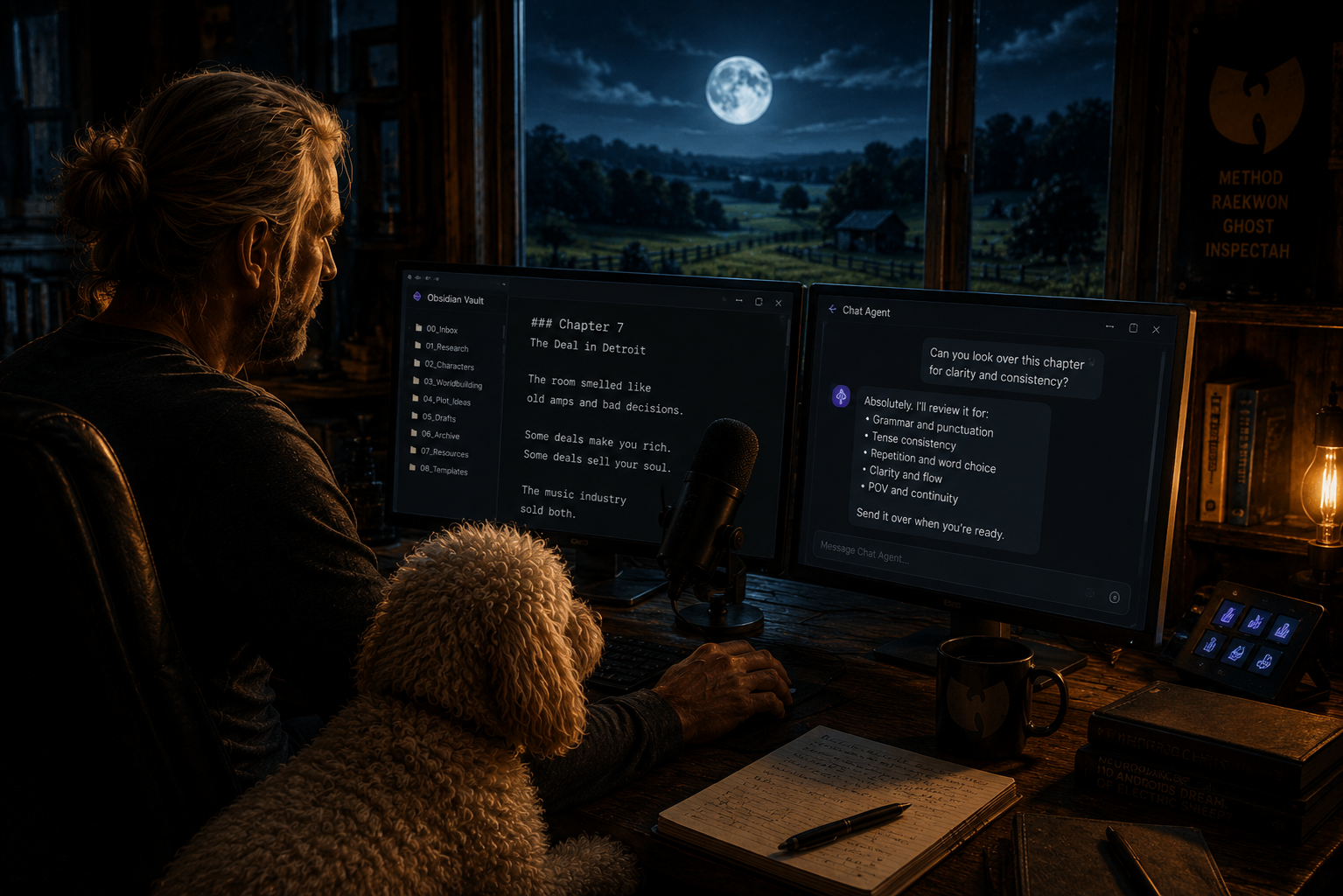
It starts with my mouth. I talk. I've got Wispr Flow running on the M4, and I just... talk at it. Pacing around the office, dog at my feet, saying the thing out loud before I've figured out what the thing is. Voice dictation turns my rambling into text, and that text drops straight into Obsidian as a markdown file. Raw. Ugly. Full of the verbal tics I'll spend the next three drafts murdering.
People think dictation is a shortcut. It isn't. It's just a different door into the same room. The words coming out of my mouth are the same words I'd have typed, except now I can write while I'm doing the dishes, which — when you've got a day job, a static blog, and four dogs who treat the mailman as an existential threat — turns out to matter.
Everything lands in Obsidian. And I mean everything. Research lives in one folder. Character notes in another. The history I'm cribbing from, the half-baked plot ideas, the line of dialogue I thought of at a red light and dictated into my phone before the guy behind me started honking. Structured folders, all of it, like a tiny library run by someone with mild OCD and too much free time. Yeah. I'm a geek. We established that in paragraph two.
Then comes the part that's actually writing. I hack at the raw draft. I move things around, cut the dead weight, find the sentence buried in the rubble that's secretly the whole point. This is slow and it's mine and there's no shortcut for it, because this is the part where the thing stops being words and starts being a thing someone might want to read.
And here's where AI finally walks into the story. After I've molded a chunk into something I actually like, I run it through a model as a first-pass editor. Not a writer. An editor. Catch the grammar I botched. Flag the spot where I accidentally slipped into first person halfway through a third-person scene — which I do constantly, because in my head I am the session guitarist with the stolen time machine, and my brain doesn't always remember he's not me. Find the place where I used "just" four times in one paragraph. The unglamorous janitorial work that every writer needs and most of us are too close to our own prose to see.
Then it goes back into Obsidian. And I keep every version. Every iteration, stacked up like commits in a git repo, because I'm a security guy and the idea of losing work makes my eye twitch. Draft three was better than draft five in one specific paragraph? Cool, it's still there. I can go dig it out. My whole vault is basically version control for my own indecision.
There's one more trick, and this one surprised me. When I get stuck — really stuck, staring-at-the-wall stuck — I'll take a paragraph or two, the ones describing a scene I can't quite see, and feed them into an image generator. Not to use the pictures. Nobody's ever going to see them. But there's something about watching a machine try to render the thing in my head that... unsticks me. It shows me what I didn't mean, which somehow points me at what I did. It's like describing a dream to someone and realizing halfway through what the dream was actually about. The image is wrong, and the wrongness is the gift.
Now, image generators do have one job where the output makes it in front of you. The artwork on these blog posts? Most of it came out of a prompt. I'll own that without blinking, and here's why it sits fine with me when the writing question doesn't. I can somewhat be called a musician. On a generous day, with the lights low, I can somewhat be called a writer. But nobody — nobody — is ever going to call me an artist. I can't draw a stick figure that looks like it wants to live. So when I need a header image for a post, I'm not shoving aside some painter I could've been. There was never a painter. The machine isn't replacing my art there, because there's no art of mine to replace. It's just keeping the blog from looking like a 1998 GeoCities page, and we can all agree that's a public service.
So that's the whole pipeline. Mouth to Wispr Flow to Obsidian to my own two hands to an AI proofreader and back to Obsidian, with the occasional weird image-generation séance when I'm blocked.
Notice what's not in there. The words. The thoughts. The choices about what this story is. Nobody handed me those. The AI doesn't know my novels about the music industry getting its soul strip-mined by streaming algorithms. It doesn't know about the GTO conversation that started the whole thing. It can fix a comma splice. It cannot care. And caring is the entire job.
I'm not here to burn it all down
Now here's where I lose half of you, depending on which half showed up.
I'm not anti-AI-writing. Full stop. I think there's a real place for it, and I'd be a hypocrite of historic proportions to claim otherwise while running half a data center's worth of models in my spare bedroom.
Think about the person who's got a genuinely good story rattling around in their skull — a war they survived, a family they want to remember, a wild idea for a novel — and just... can't get it onto the page. The words won't come out right. They freeze up. School convinced them at age nine that they "weren't writers," and that voice never shut up. For that person, an AI that helps them shape their actual memories and ideas into something readable? That's not cheating. That's a ramp into a building that used to have nothing but stairs. The story's still theirs. The machine just helped them carry it.
I think that's good. I think more stories getting told is, broadly, a thing the universe needs more of.
And honestly, I don't even know that I can write. Not really. I think I can. I think I can string sentences together well enough to be understood, and on a good day, maybe entertaining. But that's a self-assessment, and self-assessments are worth roughly what you paid for them. Maybe I'm the literary equivalent of the guy who thinks he's a great singer because the car has good acoustics. Could be. The point is I want to try, with my own hands, and find out — because the trying is the part I actually want.
So, the line I draw isn't "AI bad." I work in tech. I've watched people draw that exact line over electric calculators, over spell-check, over Wikipedia, and every single time it's been the wrong line. The line I draw is about whose story it is and how much they actually showed up for it.
Which brings me to the part where I get cranky.
The slop
Go scroll Amazon's ebook charts. Or Kindle Unlimited. Or — God help us — Audible.
Tell me you can't smell it. The covers that look like every other cover. The titles assembled out of trending keywords like a ransom note. The "author" with eleven books published this quarter, each one forty thousand words of beige nothing, all of it generated by a person who fed a prompt into a machine, hit go, slapped a price on the result, and moved on to the next one before the first had finished rendering.
It's not writing. It's not even bad writing, which would at least require a human bad at writing. It's content. It's filler. It's the literary equivalent of those YouTube channels that read Wikipedia articles over stock footage. Volume as a business model. And it's flooding the same shelves — virtual, but shelves — where the people who actually bled over their books are trying to be found.
That's the part that gets me. Not the existence of the slop. The crowding. Every garbage prompt-and-publish job is one more thing standing between a reader and someone who spent two years on a manuscript. The signal's still out there. It's just buried under an ocean of machine-extruded paste, and the algorithms that sort the shelves can't tell the difference, because the algorithms were never built to value the thing that makes a book worth reading. They count words and clicks. They don't count soul, because soul doesn't have an API.
I hate it. I'll just say it plainly. It takes something away from the art, and it does it at scale, and the people doing it mostly aren't even villains — they're just doing the thing the incentives reward, which is somehow worse than if they were evil. Evil at least has the decency to be interesting.
And yeah, I'm aware of how this sounds coming from me. The AI guy. The one with the Wu-Tang chatbots and the agent system and the genuine, no-kidding love for what these models can do. It probably reads like a contradiction.
It isn't. It's the whole point.
Loving a tool means knowing what it's for. I love a good guitar. I'd also smack you for using a vintage Les Paul as a canoe paddle. The thing I love about AI is what it can do when it's amplifying a human who's actually present — catching my typos, showing me my own scene from a weird angle, letting me write a paragraph while I'm doing the dishes. What I can't stand is watching the same technology get used to replace the human entirely and then sell the hollow result like it's the real thing.
The tool isn't the problem. The tool's incredible. The problem is the guy using a miracle to manufacture landfill.
So, did AI write this?
No. I did. Talked most of it at my computer while a dog stared at me like I'd lost it, which, fair.
A model read it after and told me I'd written "just" too many times and slipped into present tense in a paragraph I thought was past. It was right on both counts. I fixed them myself, because that's the part of editing I can do and it can't — deciding which of its suggestions is actually correct and which one would flatten the joke I was going for.
The words are mine. The opinions are mine, including the crappy ones. The typos were mine, right up until something caught them.
That's the deal I've made with the machine. It can hold the flashlight. It doesn't get to hold the pen.