The Hound of Porlock: Whispers of Forgotten Stories
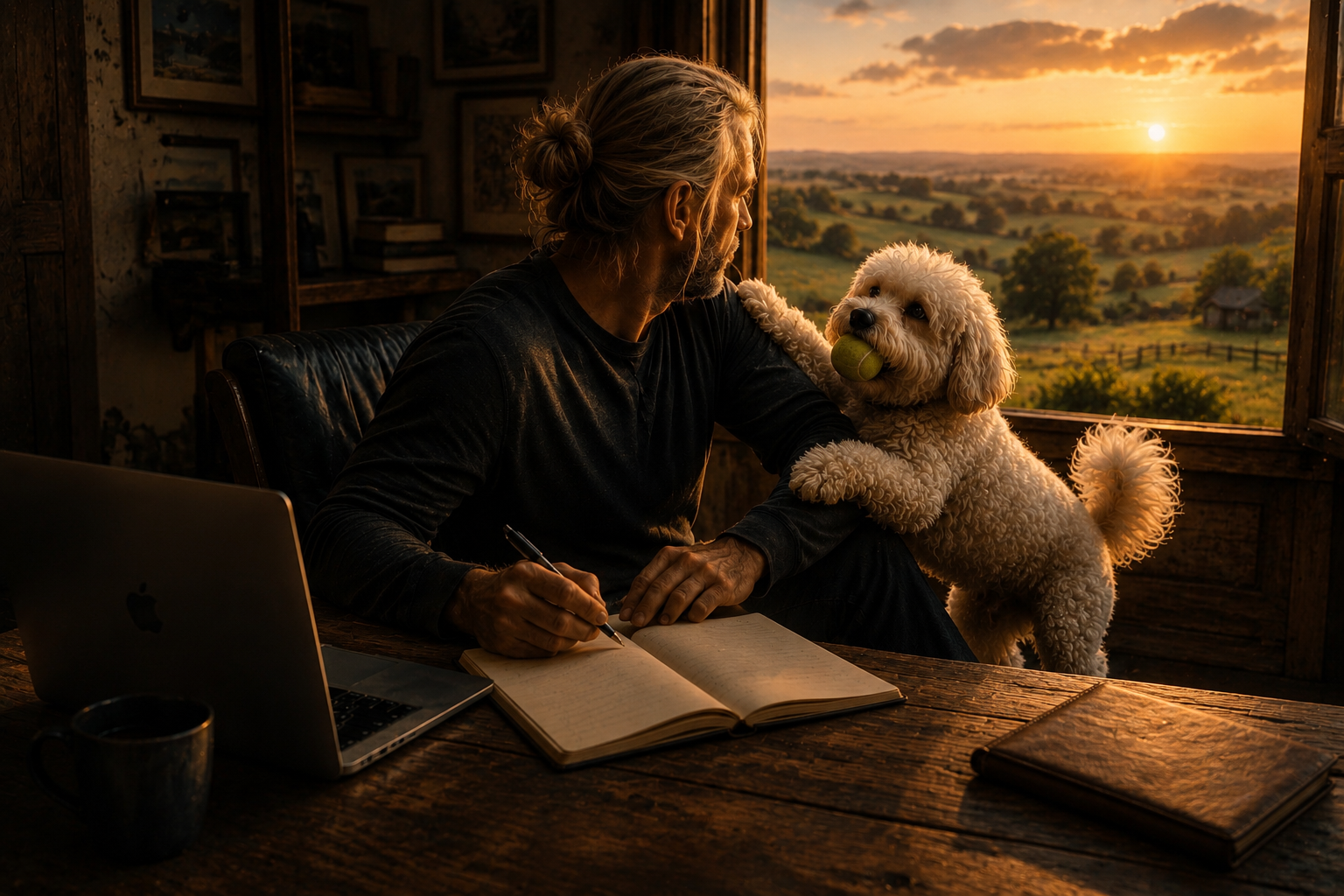
Every writer knows the cruel dance of inspiration, those brilliant, lightning-quick moments when a story materializes in the mind like a vivid hallucination, only to evaporate seconds later. It’s a torment unique to creative souls, a special kind of artistic heartbreak where entire worlds are born and die within the span of a single breath.
Imagine the scene: You’re half-awake, suspended in that realm between dreaming and consciousness. A narrative unfolds with stunning clarity. Characters breathe, landscapes shimmer, dialogue crackles with authenticity. The plot twists are revolutionary, the emotional landscape profound. You think to yourself, “Oh, this is good stuff right here!” And then… nothing. The wisp of inspiration slips through your mental fingers like smoke, leaving behind only the frustrating residue of lost potential.
But this is not a modern affliction alone. Consider the most famous tale of interrupted creativity: Samuel Taylor Coleridge’s “Kubla Khan,” a poem that stands as the quintessential example of artistic inspiration’s fragile nature. Coleridge claimed the entire poem came to him in an opium-induced dream, a complete vision of “a strange and beautiful” landscape that he was frantically transcribing upon waking. In his own account, the poem existed in his mind with extraordinary completeness, a stunning, exotic vision of Xanadu, with its “pleasure-dome” and “caverns measureless to man.”
But then came the notorious interruption. A “man from Porlock”, a nearby village in Somerset, knocked on Coleridge’s door, engaging him in some mundane business that completely shattered his creative trance. When Coleridge returned to his writing, the vision had evaporated. Only fragments remained, fragments so tantalizing that they became one of the most famous incomplete works in literary history.
The “man from Porlock” has since become a metaphorical figure in artistic circles, representing those sudden, banal interruptions that destroy moments of pure creative inspiration. Writers now use the phrase to describe any unexpected disruption that breaks their concentration and steals away a promising idea.
For me, those persons from Porlock are far more furry and enthusiastic. My own creative process is a constant battle against four-legged inspiration assassins. Picture the scene: I’m balanced on that knife’s edge of what might prove to be a creative breakthrough, fingers hovering above the keyboard, an entire universe crystallizing in my mind. Suddenly, there’s a wet nose pressed against my elbow. A tennis ball lands with a strategic thump on my laptop. Thirty pounds of fur and pure, unrestrained need begins the elaborate dance of “play with me right now or suffer the consequences.”
The novel brewing in my imagination doesn’t stand a chance against a Bichon’s weaponized cute. One moment I’m constructing intricate plot lines, the next I’m throwing a soggy tennis ball across the living room, my brilliant narrative dissolved faster than dog drool on a hardwood floor.
Writers have long mourned these spectral narratives. How many novels have been casualties of our fleeting human memory? Thousands? Tens of thousands? The number is impossible to calculate, but the collective grief is palpable. These are the ghost stories of the literary world, narratives that existed perfectly for a microsecond before dissolving into the ether.
Some blame our increasingly fragmented attention spans. In an age of constant digital interruption, our ability to hold onto a complex thought has diminished. A potential novel can be derailed by a smartphone notification, a passing conversation, or the sudden urge to check email. The creative impulse is delicate, easily scattered by the winds of modern distraction.
Neurologically, these experiences reveal the complex, mysterious nature of human creativity. Our brains generate ideas through intricate networks of neural connections, sudden, unexpected pathways that light up and then fade just as quickly. Creativity isn’t a linear process but a complex, non-hierarchical explosion of potential. The very mechanism that allows for brilliant, unexpected connections also ensures that many of these connections are transient.
Professional writers have developed strategies to capture these ephemeral moments. Notebooks become sacred objects, always within arm’s reach. Bedside tables are cluttered with journals, pens strategically positioned for midnight revelations. Some keep voice recorders, hoping to capture the raw, unfiltered essence of a nascent story before it vanishes.
There’s a profound melancholy in these lost narratives. Each represents a unique perspective, a singular vision that will never be shared. Some might have been groundbreaking, challenging literary conventions and offering fresh insights into the human experience. Others might have been simple, quiet stories that would have touched a few hearts. All are equally mourned in the writer’s pantheon of what-might-have-been.
Some writers have learned to make peace with this process. They see these lost stories not as failures but as part of a larger creative ecosystem. Each forgotten narrative contributes to the compost heap of imagination, feeding future ideas. It’s a zen-like approach: acknowledge the loss, but don’t become attached to what cannot be recovered.
There’s also a romantic quality to these lost stories. They exist in a perfect, unblemished state, never compromised by the messy realities of actual writing. In their brief moment of existence, they are pure potential, unencumbered by the technical challenges of plot development, character arc, or narrative structure.
For writers, the key is to remain both disciplined and gentle with oneself. Capture what you can, but don’t despair over what slips away. The creative mind is an ocean, sometimes turbulent, sometimes calm, always in motion. The lost stories are part of its rhythm, its inherent poetry.
So the next time a brilliant narrative concept dances through your consciousness and disappears before you can grasp it, take a deep breath. Smile, perhaps. Another idea is always just around the corner, waiting to be born, if only the dogs don’t interrupt first.
“Who’s a good boy!” “Marley are you a good boy, go get your toy!”