When the Garage Needs Three-Phase Power
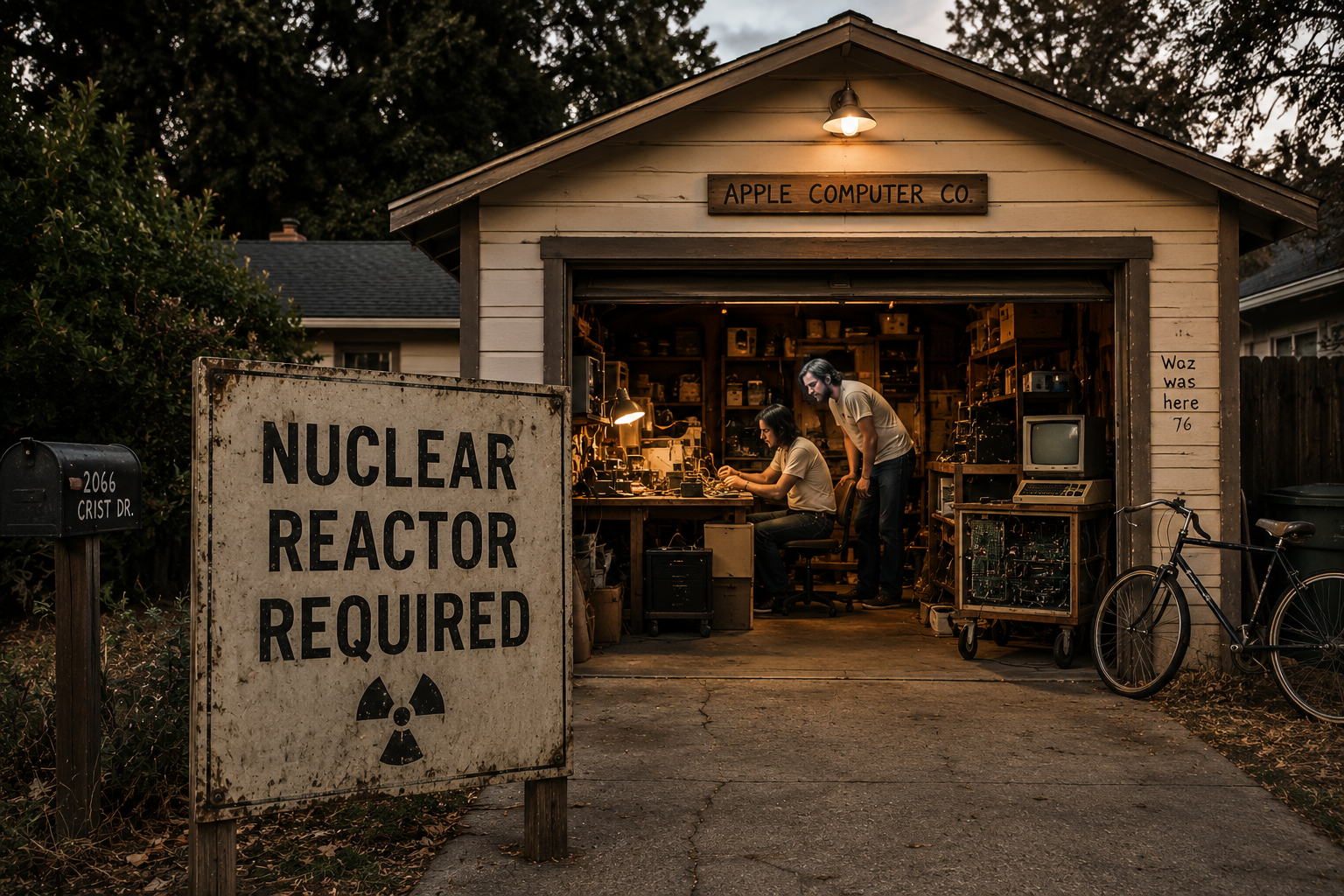
There's this story we all know. Two kids in Los Altos, sometime in the mid-70s. One of them is soldering boards in a garage. The other is preaching to anyone who'll listen that computers should belong to regular people, not just IBM. They scrape together a circuit board, a Motorola 6502, a handful of chips most people couldn't identify on a bet, and they build something. A few years later they're worth a fortune and the world looks different.
We tell that story like scripture. The garage. The two guys. The breakthrough. It's the founding myth of the entire tech industry — that anyone, with enough vision and a soldering iron, can build the next thing.
And I'm here to tell you... yeah, that's done. Officially. The garage is closed. The locks have been changed. There's a sign on the door that says "REQUIRES THREE-PHASE POWER AND A SUBSTATION PERMIT."
Because the next thing isn't a personal computer. It's AI. And AI is a rich man's game.
Let's start with the obvious
Want to train a frontier model? Cool. Get your checkbook. Then throw your checkbook away because it's not big enough. You need a wire transfer.
GPT-4, depending on whose estimate you trust, cost somewhere north of $100 million to train. Just train. That doesn't include the salaries, the failed runs, the data acquisition, the lawyers fighting about the data acquisition, the second round of lawyers fighting about the first round of lawyers. Just the raw compute. A hundred mil. To train one model. Once.
The next generation? People are throwing around numbers like half a billion. A billion. For a single training run. And nobody's blinking because the numbers have gotten so big that they've stopped feeling real, like Pentagon budgets or Elon's tweets.
Meanwhile, Sam Altman is out there talking about needing seven trillion dollars for chip manufacturing. Seven. Trillion. That's not a company budget. That's a small country.
You, sitting at home with your good idea and your enthusiasm? You're not invited.
Just run it locally
Okay, you say. Fine. I don't need to train models. I just want to run them. Open source has come a long way. Llama. Mistral. DeepSeek. Qwen. Plenty of options. I'll just buy a GPU and run my own stuff. Stick it to the man.
I love this energy. I genuinely do. I'm right there with you. Let's check the math.
Llama 3.1 405B at full precision needs roughly 800GB of VRAM. That's not a typo. Eight hundred. Gigabytes. Of VRAM. Your gaming PC has, what, 16GB if you're lucky? 24GB if you sold a kidney for a 4090?
"Okay but quantization!" Sure. Quantize down to 4-bit and you can fit it in around 230GB. Still not happening on any single consumer card. You'd need eight 4090s in parallel, and now you're talking about a $15,000 box plus a custom power and cooling setup that'll make your circuit breakers cry. Your electrical panel needs an upgrade. Your partner wants to know what that noise is. Your neighbors think you're running a meth lab.
Even the "small" frontier-ish models — the 70B parameter range, Llama 3.3, Qwen 2.5 — need around 140GB at FP16 or 40-ish gigs heavily quantized. So you're looking at a multi-GPU rig minimum, or a maxed-out Mac Studio with 192GB of unified memory, which Apple will happily sell you for the low low price of seven grand give or take.
And even if you cram the model into memory, bandwidth is the real bottleneck — the cards that can shovel data through fast enough to keep your tokens-per-second out of "watching paint dry" territory are the ones priced like a used car. There's a reason datacenter hardware costs what it does, and it's not all margin. (Okay. Mostly margin.)
The tokens are killing me
So skip the hardware. Just use the API. Pricing has come down, which is genuinely a good thing — you can get decent frontier-class output for a few bucks per million tokens. That sounds cheap! And for chatting, it is.
But here's the thing nobody tells you when you're just doing Q&A. Real applications burn tokens. Agentic workflows burn tokens like a punk drummer burns through snare heads. Every retry, every tool call, every "let me think about this step by step" — that's tokens. Every long context document you stuff in there — tokens. Every conversation you've been having for the last six hours that's now 80,000 tokens of history — yeah, you're paying for that whole context on every. Single. Turn.
I've watched my homelab AI experiments rack up bills that genuinely surprised me. Not bankruptcy surprised. But "huh, didn't expect that" surprised. And I'm a guy who works in this stuff for a living and understands what I'm doing.
The little tinkerer who just wants to play? The student trying to learn? The person with the genuinely cool idea but no funding? They get a $20/month subscription with rate limits, or they hit pay-as-you-go and watch their experiments evaporate their grocery money.
This isn't accidental. This is the business model. The labs need to recoup that hundred million per training run somehow, and "somehow" turns out to be you.
The picks and shovels
The only people who got truly rich in the gold rush were the ones selling shovels. Levi Strauss made jeans. Wells Fargo ran the stagecoaches. The actual miners mostly went broke and died of dysentery.
In our gold rush, Nvidia sells the shovels. And boy, are they selling shovels. An H100 runs $25,000 to $40,000 depending on how desperate you are and who you know. They cost something like three or four grand to manufacture. The margin is criminal. The margin is beautiful. The margin is why Jensen Huang now owns a small fleet of leather jackets that probably cost more than my home.
Microsoft, Meta, Google, Amazon — they're each spending tens of billions on Nvidia chips. Tens of billions. Per quarter. Nvidia's market cap blew past three trillion dollars and people just kind of nodded.
Meanwhile, if you're an academic researcher, a small startup, an independent who wants to do real work, you're waiting in line behind hyperscalers who are buying every H100 off the assembly line before it's cooled down. Good luck getting hardware. Good luck even getting cloud capacity some weeks.
Power. Literally power.
Microsoft is restarting Three Mile Island. Not because they suddenly love nuclear. Because they need the gigawatts. AWS bought a nuclear-powered datacenter campus. Google's signing deals for small modular reactors. The grid in Virginia — my grid, the one running my homelab right now — is straining under datacenter demand to the point where utilities are asking regulators for the right to build new gas plants just to keep up.
The garage doesn't need three-phase power anymore. The garage needs a reactor.
When the cost of entry to your industry includes building or buying nuclear power infrastructure, you have officially exited the realm of "two kids and a dream." You're in the realm of nation-states and trillion-dollar corporations. That's it. Those are the players. There are no others.
So what?
I'm not saying it's hopeless. There's still cool work at the edges — open weights keep getting better, quantization keeps improving, and there's a whole indie community squeezing surprisingly capable models onto Raspberry Pis and old gaming rigs. I love them for it. Some of my favorite weekend projects live right there.
But let's not pretend it's the same. Let's not tell the kids that anyone with a soldering iron and a dream can build the next OpenAI. They can't. The next OpenAI gets founded by people who can raise a billion before lunch, who have the right Stanford connections, who know which VCs to call. That's the actual game now.
The rest of us get the API sandbox. We fine-tune the leftovers and build clever wrappers around the magic boxes the rich kids own. There's real work at that layer — I'm doing some of it, you probably are too. Just don't mistake it for what Jobs and Wozniak did. They built the thing. We're decorating someone else's thing. The actual machinery, the actual frontier, the actual decisions about where this goes — that's happening in rooms we'll never be invited into, between people who own utilities and chip foundries and researchers commanding transfer fees that'd make Premier League clubs blush.
The garage is closed. The two-guys-and-a-dream era is over. And whatever comes next, it's not coming from someone like you or me. It's coming from someone whose seed round was bigger than the GDP of a small island nation.
Anyway. I'm gonna go boot up my Mac mini and pretend I'm building the future.
It's cheaper than therapy.